
Which light bulb produces more near-infrared (NIR) light: an incandescent or an LED? To answer this question accurately, we have to first select the type of infrared LED bulb and then compare the two bulbs when operated at the same electrical power. For this comparison, let’s select a 20 watt NIR-enhanced LED bulb from PhosphorTech Corporation then compare it to a 20 watt incandescent bulb, as shown below.
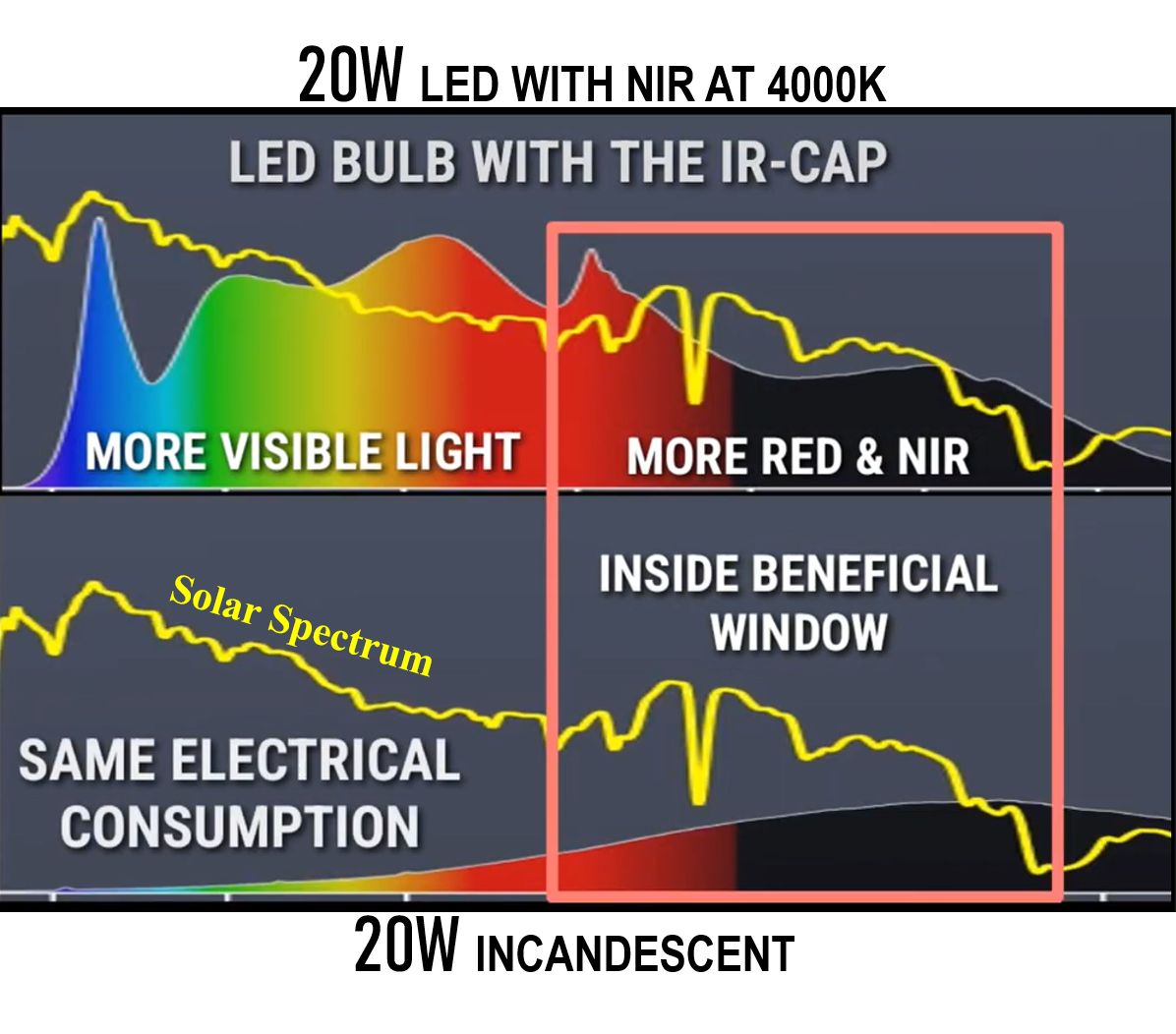
An LED bulb with the IR-CAP technology actually produces more near-infrared (NIR) light inside the beneficial human tissue transparency window compared to an incandescent bulb for a given watt of electricity. It also produces significantly more visible light.
Not only does a NIR-enhanced LED produce significantly more visible and deep red light, it also delivers more energy overall within the beneficial IR spectral window compared to an incandescent bulb operating at the same wattage. The above data focuses on the primary human tissue NIR transparency window between 650-950nm since that’s where the majority of photobiomodulation (PBM) studies have demonstrated health benefits.
Below we have an IR-SENSE photo comparing different light bulbs once again being operated at the same power. All appear “warm white” to the eye but the difference in the amount of invisible NIR light present is striking. while the standard LED does not produce any NIR, the LED with the IR-CAP produces more NIR than an incandescent bulb.
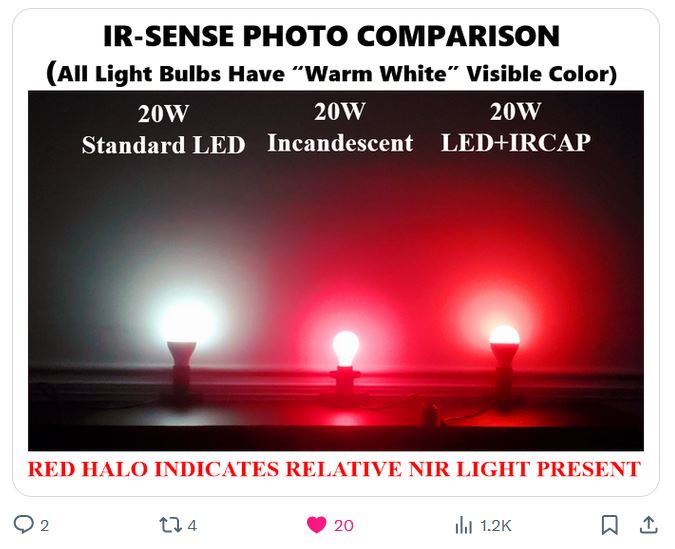
IR-SENSE photo comparison of different bulbs being operated at the same electrical wattage
Both LED types emit more visible light when compared to an incandescent at the same wattage. Despite the high visible content, the light from the LED with the IR-CAP is far more pleasant and comfortable to look at because it delivers a balanced visible, deep red, and near-infrared spectrum.
Unlike an incandescent bulb that has a fixed NIR to visible ratio, the IR-CAP technology can be modified to deliver any spectral ratio needed for a specific application. For example, more IR energy past 1200nm can be produced using such technology but that will generally come at the expense of reduced visible brightness and/or higher power consumption.